What Makes a Product Rank on Google? The Product Selection + Shopify SEO Formula
Learn how insightful product selection and Shopify SEO execution can help your product rank on Google

Learn how insightful product selection and Shopify SEO execution can help your product rank on Google
A product ranks on Google when it meets users’ real search intent, is well optimised for on-page SEO, and has consistent user engagement. On Shopify, this means searching for those products that already have high demand, low to medium competition, and clear search intent. Additionally, these are optimised through keyword listing, structured data, and conversational content.
This article discusses trends in product demand and SEO performance insights observed on Shopify stores, along with insights from Sell The Trend, an AI-driven platform used to identify product trends and signals of buyer demand.
Traditionally, SEO’s primary focus has been rankings only. But now, AI-based results like Google AI overviews have come into the picture, and they are changing how content is shifting towards more structured and entity-rich.
This change has made product selection and SEO execution more connected than before. Now, it is not sufficient to find only the trending product. What matters is ensuring that the product is discovered by the modern search system and how and where it is visible to the audience.
What it means is:
It is not sufficient to rank at #1.
The AI search engines should easily read and understand the content.
Structured data and consistency have become more important than ever.
The stores that completely rely on keywords might not be suitable for AI-driven search results.
A product ranks on Google when it addresses three factors: search demand, level of competition, and relevancy of content. Ranking becomes easier if people are actively searching for your product, the competition is manageable, and if it gives a detailed and better answer to the users’ query as compared to other products in the market.
The search engines now just don't rely on and focus on keywords, but on search intent. For instance, if a user searches for “ergonomic office chair for back pain”, then Google will prefer and rank those products that directly solve the user's problem and meet their search intent. It will not rank pages with generic listings.
Factors for ranking are:
Search volume: If the product has more than 1K monthly searches, it means it has consistent demand.
Choice of keywords: Long-tail keywords have 2-3x conversion chances.
Content length: Pages having 300-800 words perform better and rank higher.
User signals: Click-Through-Rate (CTR), bounce rate, dwell time.
Page speed: Shopify stores that load in less than 2.5 seconds rank higher and faster.
The product selection stage is important for setting the foundation, and the execution level decides if you are actually ranking. Here, many Shopify stores fail to perform and then rank. They might choose the right products, but they fail to understand and execute the structured SEO layer for better visibility. Platforms like SEOKart help solve these issues by optimizing the product pages as per the SEO norms. It works on meta tags, the structure of the content, schema data, and internal linking. This helps stores to not only index, but rank well for both traditional and AI-based search results.
Product selection plays an important role in SEO, even more than people think. This is because you can’t rank for something that people aren’t searching for yet. Even the best SEO strategies can’t create user demand; all they can do is capture and rank the existing demands. Therefore, if you select the wrong product, you compete in a zero or very low search volume category.
Many beginners focus on:
Backlinks
Meta tags
Technical SEO
However, they usually skip the most important aspect: fitting the product market in the search engines.
Let’s understand this with examples:
A trending TikTok gadget might go viral and drive short-term traffic due to its hype.
But if it doesn’t have long-term search demand, the SEO traffic declines fast.
On the other hand,
Query “posture corrector brace” might not get viral quickly
But it can generate more than 10K monthly searches successfully with consistency.
AI-enabled product research helps you filter products based on:
Past search trends.
Market saturation level.
Different engagement at different marketplaces.
This ensures that you are establishing your SEO on a stable demand and not only on a hype basis.
Even if you have chosen a correct product, weak on-page SEO might not allow you to rank in the desired place. Many products don’t rank even after selecting the right product because their meta tags, structure, and technical SEO are not consistent and up to the standard mark. This problem is easily resolved through automation tools that help standardize optimization for several product listings.
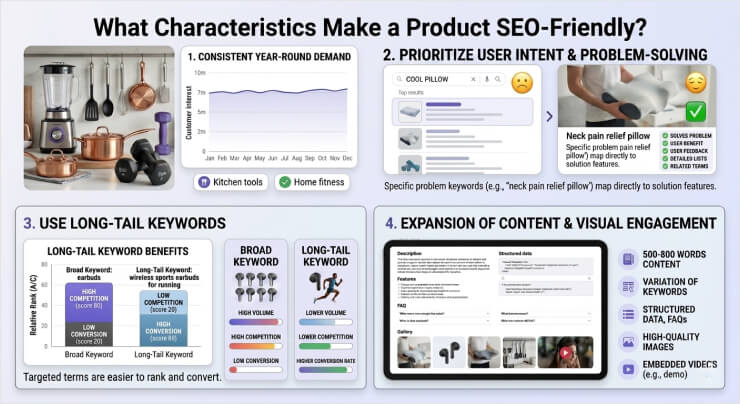
A SEO-friendly product has a regular search demand, clear buying intent, manageable comparison, and a detailed and content-rich product page. All these factors together help Google to understand your product, make it rank, and recommend it to other users.
There are some important traits for it:
Products that people search for the entire year, like kitchen tools, fitness accessories, etc.
Avoid using short-term trends unless they have some long-tail SEO keywords.
The products that help in solving users' problems tend to rank better.
For example, use “neck pain relief pillow” instead of “cool pillow”.
We recommend using long-tail keywords as they are easier to rank. For example, “wireless earbuds for running” will rank faster than “earbuds”.
The competition for these keywords is less and the conversion rate is higher.
Can you create highly relevant content in 500-800 words? If yes, do that; there are more chances of it ranking higher.
Always include FAQs, structured data, and a variation of keywords.
Deploy tools like SEOKart for optimizing meta tags, alt texts, and structured snippets.
Use high-quality images as they increase the dwell time.
Use videos, especially from TikTok, as they improve the conversion rate.
You should focus on products having a continuous demand the entire year. Focusing on products with sudden spikes is not reliable. Stable and demanding products eventually result in compounding SEO traffic.
How Do You Find Products That Already Have Ranking Potential?
You can easily find products that are ranking and have good potential using AI tools and the market. Analyze the search data, level of competition, and trend to find the relevant and suitable products for you. The main objective is to research the demand and validate it before making a store.
Here’s a proven process for this:
Employ the methods that check for:
Search volume per month (aim for 1K-10K+ searches)
Seasonal trends
Determine:
The ranking websites' domain authority
Content quality
Backlink profile
If you find any weak points among Shopify-powered stores, then this means there is an opportunity for you.
Know what trends in products:
Shopify websites
Product pages on Amazon
TikTok user engagement
Most people rely on websites like “Sell the Trend.” This is not based on guessing; it is based on analysis of the live data to ascertain demand.
Live engagements
Suppliers available
SEO for fulfillment is important because:
Fast delivery ensures customer satisfaction.
Low refund rate builds trust.
Once a product validation is complete, focus on consistent optimization of all the pages. For stores with 50-500+ products, it becomes challenging to optimize pages manually. This is where SEO platforms such as SEOKart come in handy, as they can help bulk-optimize page elements such as title tags, descriptions, and images. Moreover, it increases consistency among all the categories and product pages.
The formula for Shopify SEO + production selection is as follows:
Demand-Validated Product + Search-Optimized Page + Strong Conversion Signals = Consistent Rankings and Sales
Let’s understand this step-by-step:
| Component | Role in Ranking | Outcome |
|---|---|---|
| Product Demand | Ensures people are searching | Ensures people are searching Organic traffic potential |
| Keyword Optimization | Matches search intent | Higher rankings |
| Content Depth | Improves relevance | Better indexing |
| User Experience | Reduces bounce rate | Higher dwell time |
| Conversion Signals | Boosts engagement | SEO reinforcement |
| SEO Automation (e.g., SEOKart) | Standardizes optimization at scale | Faster execution, fewer errors |
Manual product research is based on guesswork and random information, whereas AI product selection uses real-time analytics, trend prediction capabilities, and linking across multiple platforms to find high-potential products based on more reliable data and at a significantly faster rate than the other method.
Example of both methods and their outcomes:
| Approach | Result |
|---|---|
| Manual product research | Slow, inconsistent, high risk |
| Trend-based guessing | Short-term wins, unstable traffic |
| AI-driven product research (Nexus AI) | Faster, data-backed, scalable |
| Integrated platforms (Sell The Trend) | End-to-end automation + insights |
| SEO Execution Tools (SEOKart) | Automates audits, bulk edits, and tracking for scalable and consistent optimization |
AI tools have taken research time from taking hours to produce results, down to minutes; an increase in accuracy through the use of the following:
Predictive trend detection.
Engagement tracking.
Market saturation score.
If you cannot find at least 3 sources of data (search, marketplace, social) to confirm a product's validity, you should not invest in creating SEO for that product.
User behaviour will affect rankings by way of engagement signals such as click-through rate, time on page, and conversion rates. Google uses these signals to measure how well your products meet the original intent of the searcher.
The key engagement metrics include:
CTR (Click-Through Rate): The higher the CTR, the greater the value
Dwell Time: Longer time on site helps to improve rankings
Bounce Rate: A high bounce rate will indicate a poor match
Conversion Rate: Actual sales of the product help to demonstrate its value
Improvement of these signals generally needs to happen via technical and on-page optimisations, many of which will need faster load time, better structured metadata, and better optimised images. A dedicated SEO app for Shopify, such as SEOKart, will assist with many of these improvements, such as those relating to page speed, image compression, and structured data, thus impacting all of the above engagement metrics.
The following items are critical for Shopify Stores:
Clear product descriptions
Pages load quickly
Strong visuals and reviews
The most effective SEO strategies for Shopify combine tools for product intelligence (what to sell) with SEO execution (how to rank it).
SEO Execution Layer:
SEO audits across 15+ ranking factors
Bulk meta tag & alt text optimization
Track Your Rankings By Keyword and Competing Stores
Track Rich Snippets To Increase Click-Through Rate (CTR)
Use Google Analytics To Review Revenue + Traffic Insights
Product Discovery Layer:
Sell The Trend (Nexus AI, Find Trends, Automate Suppliers, Setup Store)
Legacy tools like Minea, Dropship, Ecomhunt
Validation Channels:
Shopify
Amazon
TikTok
Yes, but only if short-term trends are converted into long-tail SEO opportunities. The trending product tends to be more unstable, so it must be turned into a long-tail opportunity when paired with keyword targeting and content for a lasting traffic stream.
Example plan:
Identify a trending product from TikTok
Identify long-tail keywords
Build SEO Optimized product pages
Add blog posts as support
The combination of these would yield:
Immediate traffic from the trend
Long-term traffic from SEO
Use term(s) that define a problem, vs just using the item in your naming of the products for SEO. Use a problem-based keyword and not just the product name.
1. How can I efficiently optimize hundreds of Shopify product pages?
If you want to scale beyond 20-30 products, manually optimizing each page will not work. Using Shopify SEO apps like SEOKart allows you to automate bulk editing of meta tags, such as alt text and structured data, so that all of your product pages have consistent data, which saves you a lot of time.
2. What is the biggest mistake made when doing Shopify SEO?
Selecting products with no website traffic. You cannot create enough seo on any product to make up for zero search traffic.
3. How many keywords should a product page be optimized for?
1 primary keyword and 3-5 long tail variations are best; you will dilute each keyword's effectiveness by competing with one another.
4. Can a new store on Shopify rank on Google?
Yes, but typically, optimizing for long-tail keywords with little competition makes product selection the biggest advantage for new stores.
5. How long will it take to rank a new product page?
Usually 3-6 months, and this is highly dependent on your competition's current rankings, the overall content quality on your product page, and your domain's authoritativeness.
6. Will optimizing for trending products help in SEO?
Only in the short term, as you will not continue to maintain that traffic/ranking without consistent traffic demand.
7. Is artificial intelligence necessary for product research?
No, it is not required that you use AI tools when conducting product research, but it significantly improves speed and accuracy, especially for beginners.
SEO and product selection are interrelated strategies. The correct product generates traffic opportunities, while SEO captures that traffic and converts it into sales.
Shopify store owners can create sustainable and compoundable traffic with demand-first product selection and appropriate SEO applications.
The benefits of ranking go beyond simply achieving a high-ranking product; they also include generating sales through high-ranking products.
If you want to succeed with your Shopify store, you need to be present at the time of making a buying decision. This takes place when consumers search for products on websites or receive AI-generated answers.
You can accomplish this through validation using demand-pull product selection and structured SEO processes. Shopify apps like Sell The Trend identify products with potential, and SEOKart allows you to optimise those products across traditional searches (organic and paid) and AI Search.